


Navigating the Kenya Data Protection Act 2019: A Strategic Guide for Modern Organizations
Data is the new currency of modern business, and like all currencies, it must be handled responsibly. For Kenyan organizations, that responsibility is now enshrined in law.
Overview
Navigating the Kenya Data Protection Act 2019: A Strategic Guide for Organisations

Before you read further: this is an informational guide, not legal advice. The Act and its regulations should be read alongside current ODPC guidance, your sector's requirements, your contracts, and any relevant court decisions. Talk to a qualified Kenyan lawyer before making a specific compliance call.
Privacy is not a paperwork exercise
The mistake I keep seeing: an organisation publishes a privacy notice, appoints someone as data protection officer, and checks the box. That approach fails because the Kenya Data Protection Act, 2019, regulates what you actually do with personal data — not what your policy says you do.
The Act gives effect to the constitutional right to privacy. It sets up the Office of the Data Protection Commissioner (ODPC) and regulates how controllers and processors handle personal data. It covers organizations based or ordinarily resident in Kenya. It also reaches entities outside Kenya that process personal data of people located in Kenya. That extraterritorial reach catches a lot of organisations off guard.
Consider where personal data lives in a typical organisation. Recruitment. Payroll. Customer acquisition. Credit checks. CCTV. Mobile apps. Websites. Customer support. Analytics. Cloud hosting. AI. Loyalty programmes. Supplier management. It is everywhere. The Act is supplemented by the 2021 General, Registration, and Complaints Handling and Enforcement Regulations. The consequence is straightforward: compliance is not an IT problem. It belongs to the board, executive team, product, marketing, HR, finance, information security, procurement, and legal. Everyone.
The ODPC's published 2026 determinations make this concrete. The listed matters involve banks, insurers, hospitals, schools, utilities, and credit providers — ordinary organisations, not just big tech. There is also a suo motu investigation. If you think data protection enforcement is a problem for someone else, you should probably think again.
1. Start with your actual data reality
The first task is not drafting a policy. It is building a reliable picture of what your organisation actually does with personal data. You cannot demonstrate lawful, fair, transparent, or secure processing if you do not know what you hold, where it came from, why you use it, who can access it, where it is stored, how long you keep it, and who receives it.
The Act defines processing broadly — collection, recording, organization, storage, alteration, retrieval, consultation, use, disclosure, transmission, combination, restriction, erasure, and destruction. A spreadsheet in HR. A customer list in a CRM. An employee ID in payroll. A voice recording in a call centre. A face on CCTV. All of it falls within the organization's data-protection environment.
Build your inventory around processing activities, not databases. For each activity, record: the business owner, the categories of data subjects, the personal-data fields, the purpose, the lawful basis, recipients, storage locations, retention period, cross-border flows, security controls, and the process for handling data-subject requests.
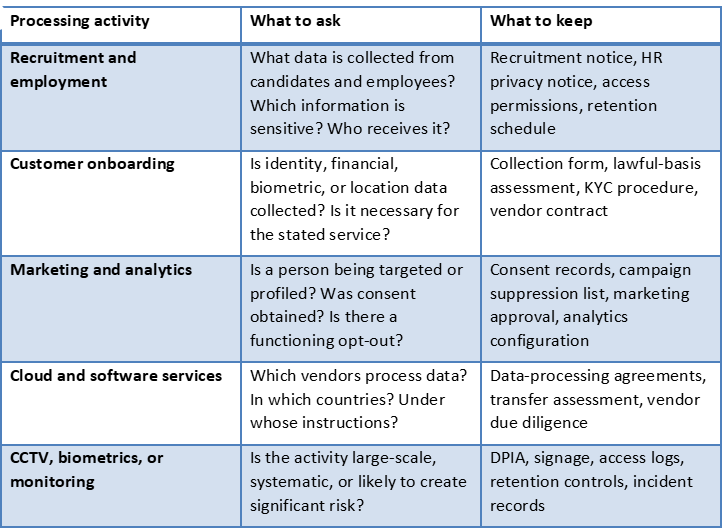
This inventory is the bedrock. Your records of processing, privacy notices, retention schedule, vendor controls, DPIAs, and audit programme all depend on it. Without it, you are reacting to problems instead of preventing them.
2. Get the governance model right
The Act draws a line between a data controller (which determines the purposes and means of processing) and a data processor (which processes on behalf of a controller). The distinction is functional. You cannot sidestep controller responsibilities by calling yourself a processor if, in practice, you decide why and how data is used.

A processor must stay within the controller's lawful instructions. Process data outside those instructions, and the regulations reclassify you as a controller for that activity. This has real consequences for technology vendors, marketing agencies, payroll providers, call centres, cloud providers, fintech platforms, and outsourced service providers.
The board or executive team should approve a governance model that answers four questions: who owns each processing activity; who approves the lawful basis; who manages operational controls; and who reports incidents or rights requests. Build in an escalation route to senior leadership for high-risk processing and serious breaches.
Section 24 of the Act provides for the appointment of a data protection officer in certain situations: public-body processing, regular and systematic monitoring, and processing of sensitive categories of personal data. A DPO may perform other tasks, but not where there is a conflict of interest. The organisation must publish the DPO's contact details and communicate them to the Commissioner.
Even where a DPO is not legally required, appointing a competent privacy lead is usually the right call. Someone has to own this. And the DPO role should not be ceremonial — it needs access to decision-makers, independence, authority to review new projects, a budget for training and audits, and a direct line for escalating unresolved risks. A DPO without real authority is arguably worse than no DPO at all, because it creates a false sense of compliance.
3. Stop defaulting to consent
Consent matters. But it is not the answer to everything, and treating it as such creates risk.
Section 30 of the Act permits processing where the data subject consents, or where processing is necessary for other specified purposes: performing a contract, complying with a legal obligation, protecting vital interests, performing a public-interest task, exercising official authority, pursuing a legitimate interest that does not override the data subject's rights, or conducting recognized research, journalistic, statistical, literary, or artistic activity.
The requirement: choose and document your lawful basis before processing begins. The General Regulations state that the basis must be demonstrable and that if you are using different bases for different activities, you must distinguish them. A blanket consent statement should not be used to cover several unrelated purposes.
Consent must be voluntary, specific, informed, and withdrawable. The consent notice should explain the identity of the organisation, each purpose, the categories of data, any relevant automated decision-making, possible transfer risks, third-party sharing, the right to withdraw, and the consequences of giving, withholding, or withdrawing consent.
This bites hardest in employment, digital lending, education, healthcare, and platform businesses — settings where a data subject may have limited bargaining power. Making a service conditional on consent to processing that is not necessary for that service may undermine the claim that consent was freely given.
Build a lawful-basis matrix instead. Link every processing activity to one clear basis, one purpose, one notice, and one set of controls.
4. Make transparency match reality
The Act requires organisations to inform individuals before collecting personal data, as far as practicable. The notice should cover the individual's rights, the fact and purpose of collection, third-party recipients, safeguards, contact details, whether collection is mandatory or voluntary, and the consequences of not providing the requested data.
A privacy notice is not just a legal disclaimer tacked onto a website. It is the interface between your organization and the data subject. It should be understandable to the intended audience, available at the point of collection, and — this is the part people skip — consistent with what your systems actually do. If a mobile app sends location data to an analytics provider, or a marketing form shares contact details with an external campaign platform, the notice must not imply otherwise.
Put a change-control process in place for privacy notices. Product launches, new analytics tools, acquisitions, new vendors, new countries of storage, new marketing purposes — all of these should trigger a review. The most dangerous notice is the one that was accurate two years ago but no longer describes what the organization is doing.
5. Build a rights-request service, not an email inbox
Data-subject rights are operational service obligations. A person may request information about the use of their data, access, objection to processing, correction, restriction, erasure, or portability — subject to the conditions and exceptions in the Act and regulations.
Publish one request channel. Verify identity proportionally. Route the request to the correct system owner. Track deadlines. Retain an audit trail. And make sure the process covers data held by processors and other recipients, not just your central database.
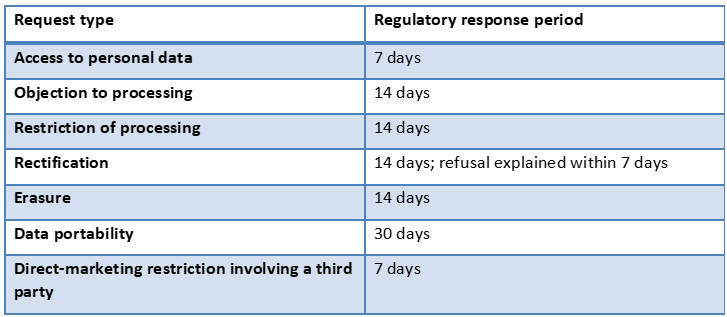
These periods come from the General Regulations. Build them into your workflow. They are not informal targets. Access requests should generally be free. Portability fees, where charged, should be reasonable and not exceed the actual cost.
If a data subject escalates to the ODPC, the Complaints Handling and Enforcement Regulations allow complaints to be lodged orally, electronically, by an authorised person, or anonymously, without charge. The ODPC must acknowledge receipt within seven days. Keep the records you need to respond quickly when a complaint arrives.
Direct marketing is where I see the most sloppiness. The General Regulations permit direct marketing where the data was collected from the data subject, the person was notified that direct marketing was a purpose, consent was obtained, a simplified opt-out mechanism exists, and the person has not opted out. Every campaign should connect its audience list to consent evidence and a suppression mechanism that works across email, SMS, telephone, social media, and outsourced agencies. If you cannot connect a contact on your list to a consent record, you should probably not be messaging that contact.
6. Treat sensitive data and children's data as high-risk assets
The Act identifies sensitive personal data categories: health status, race or ethnic origin, beliefs, genetic and biometric data, property details, marital and family details, sexual orientation, and related information. These deserve stronger controls because the harm from misuse is more serious — discrimination, identity risks, reputational damage.
Children's data requires parental or guardian consent, processing that protects and advances the child's best interests, and appropriate mechanisms for age verification and consent. Do not assume a general website notice or ordinary adult consent process is sufficient where children are likely to use the service. The ODPC publishes specific guidance on children's data and other high-risk topics.
For both categories, the first question is, 'Do you need this data at all?' Data minimisation is often a stronger control than collecting sensitive data and then trying to secure it. If a business objective can be achieved with aggregated, anonymised, or pseudonymised data, use the lower-risk option.
7. DPIAs are decision tools, not afterthoughts
A data protection impact assessment (DPIA) is a decision tool. It is not a form you complete after the project has already been approved. The Act requires a DPIA before processing likely to create a high risk to the rights and freedoms of data subjects. The assessment should describe the processing, assess necessity and proportionality, identify risks, and specify safeguards.
The General Regulations identify high-risk activities: significant automated decisions and profiling, large-scale processing, biometric or genetic data, sensitive or children's data, linking datasets from different sources, large-scale monitoring of public areas, innovative technologies, and processing that prevents a data subject from exercising a right.
This hits directly at AI, fraud scoring, facial recognition, behavioural analytics, employee monitoring, geolocation, and automated credit or recruitment decisions. The assessment should ask hard questions. Is the purpose legitimate? Is the data necessary? Is the model accurate? Could bias or discrimination occur? Can a human intervene? Can the individual challenge the outcome? Can the vendor's system explain the logic?
Where the DPIA indicates high residual risk, the Act requires consultation with the Data Commissioner before processing. The report must be submitted 60 days before processing begins. Do not launch first and try to regularise afterward. I have seen organisations try this. It does not end well.
8. Privacy by design means procurement discipline, too
Sections 41 and 42 require appropriate technical and organisational measures to be embedded into processing and applied by default. The Act mentions risk assessment, safeguards, pseudonymisation, encryption, timely restoration of access, verification of safeguards, and continuous updating in response to new risks.

The General Regulations add practical expectations: access control, backups, logs, audit trails, event monitoring, breach-handling routines, software testing, and special protection for sensitive data. These are not instructions to buy a particular security product. They are requirements to implement controls proportionate to the nature, volume, sensitivity, and risk of what you are processing.
Procurement has to be part of this. Before engaging a processor, the controller should assess its security, sub-processors, incident response, retention, deletion, auditability, access controls, and cross-border arrangements. The written contract must describe the subject matter, duration, purpose, data types, data-subject categories, instructions, confidentiality, security measures, deletion or return at termination, and audit provisions.
Do not accept a vendor's standard terms where they conflict with your role as controller. And avoid a trap I see repeatedly: allowing a processor to appoint sub-processors without prior authorization, or without flowing down equivalent contractual safeguards.
9. Prepare for breaches before they happen
A breach plan should be tested before an incident — not drafted while systems are under investigation.
Under section 43, where personal data has been accessed or acquired by an unauthorized person and there is a real risk of harm, the controller must notify the Commissioner without delay and within 72 hours of becoming aware. A processor must notify the controller without delay and, where reasonably practicable, within 48 hours.
Your internal plan should establish a 24-hour reporting channel, an incident commander, legal and technical escalation, evidence preservation, decision criteria for notification, customer communications, and a process for documenting facts, effects, and remedial action. The General Regulations specify what the notification should contain: when you became aware, what occurred, the number and categories of affected persons, likely harm, mitigation measures, and contact details.
72 hours is not a lot of time. Do not wait for a perfect forensic report. Notify with what you know and supplement it without undue delay. At the same time, not every security event is a notifiable breach. Assess whether the statutory real-risk-of-harm threshold is met. Record your reasoning.
10. Do not confuse cloud convenience with transfer lawfulness
Modern organisations move personal data through international cloud platforms, payment gateways, customer support tools, email services, analytics providers, and group-company systems. Where your head office sits is not a substitute for a transfer analysis.

The Act and General Regulations require international transfers to rest on an appropriate safeguard, an adequacy decision, necessity, or consent, depending on the circumstances. Safeguard-based transfers should be documented with the date and time, recipient, justification, and description of the data transferred. Sensitive personal data transferred outside Kenya requires consent and confirmation of appropriate safeguards.
A practical transfer assessment should identify the destination country, recipient, categories of data, purpose, onwards-transfer risk, contractual safeguards, technical protections, and what the data subject has been told. Do not claim that "the data is secure because the vendor is reputable." Security and transfer lawfulness are related but separate questions.
For specific strategic state-interest processing, the General Regulations require processing through a server or data centre in Kenya, or at least one serving copy in Kenya. The listed areas include civil registration, elections, public finance systems, protected computer systems, basic education, and primary or secondary healthcare. Get sector-specific advice where these categories are relevant.
11. Figure out whether you need to register
The Registration Regulations distinguish a controller from a processor and provide for registration certificates valid for 24 months. There is a general exemption where annual turnover or revenue is below KSh 5 million and the organisation has fewer than 10 employees. But that exemption does not apply if you process data for mandatory-registration purposes: education, health, financial services, telecommunications, direct marketing, transport, property management, hospitality, gambling, political canvassing, CCTV-related crime prevention, and genetic-data processing.
The registration exemption is not the same as exemption from the Act. Even an organisation that qualifies for the registration exemption remains subject to the core principles and international-transfer obligations. Registration is only one part of compliance.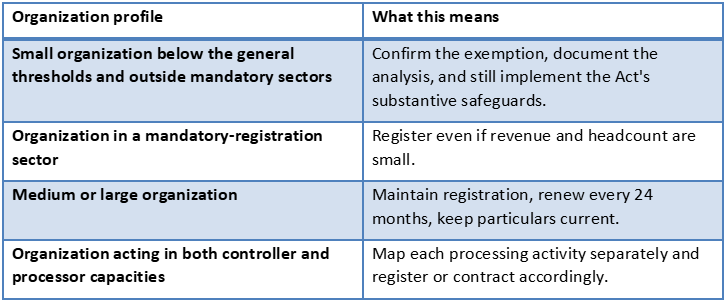
A registration certificate is an accountability signal, not the finish line. It does not validate your privacy notices, security controls, rights process, or vendor governance.
12. Build a 90-day compliance programme
Organisations usually fail when they launch an abstract "compliance project" without sequencing decisions. A focused 90-day programme can create a defensible baseline.
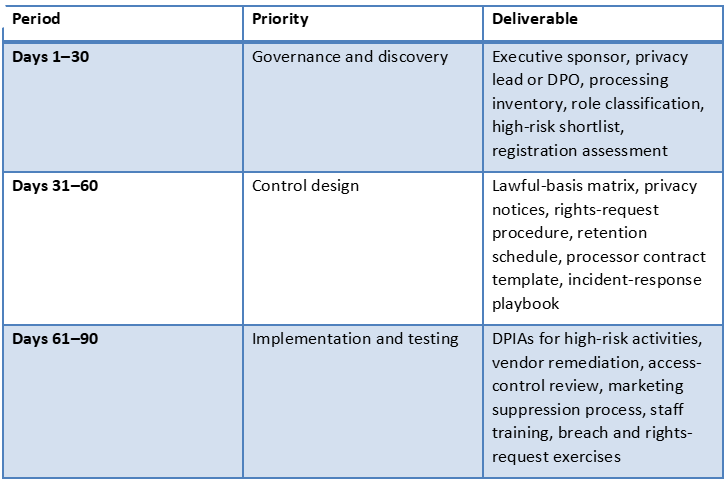
After the first 90 days, shift to a recurring cycle: risk assessment, project review, vendor monitoring, rights-request testing, retention audits, staff refreshers, and management reporting. Measure the programme by evidence, not by how many policies people have signed.
13. Give the board what it actually needs
A board does not need a recitation of legal provisions. It needs a clear view of exposure and whether controls are working.
Useful metrics: the percentage of processing activities with a documented lawful basis, the number of overdue rights requests, the percentage of critical vendors with compliant contracts, the age of unremediated high-risk findings, the time taken to escalate incidents, the percentage of staff trained, and the volume of personal data past its retention period.
Give the board a short register of strategic decisions, too: new high-risk technologies, material data-sharing arrangements, international transfers, major incidents, regulator correspondence, and exceptions to policy. This creates a record that privacy risks were identified, considered, and managed at the right level.
The real standard
The Kenya Data Protection Act is not a narrow privacy-law problem. It is a governance and operating model for how an organisation acquires, uses, shares, secures, retains, and deletes information about people.
The organisations that get this right stop asking, "Do we have a privacy policy?" and start asking harder questions. Does the policy match what our systems actually do? Is the lawful basis documented? Can we control our vendors? Can data subjects exercise their rights? Has high-risk innovation been assessed? Can we report a breach within the statutory window? Can leadership prove that risk decisions were made deliberately, not by accident?
Know the data. Justify the purpose. Minimise the exposure. Design for privacy. And keep the evidence that you did.
Share This Resource
Related Resources
More guides you might find useful